
I’ve been interested in “personal OS” since at least 2011.1 By 2018, I’d started writing very rough specs for the “Ellen Dashboard.”
Starting conditions: Whoop data · Personal tracker data · Recent emoji moods · People data (Airtable) · Hapyr/Gratitude data
React. Backend in dark. Scrape whoop. Scrape google sheets.
Since 2026 started, I finally got to the place where I have a genuinely interesting version of this.
It hit me this morning when I sat on the Amtrak website, actively expecting it to book the train for me. My system had already identified the best day left in 2026 to go to NYC. It created draft emails and schedules for the people I wanted to see (and knew which slots should be for who). It set up the Todoist item to remind me to pack the day before, and generated the packing list for one day, NYC. It just hadn’t actually booked the ticket.2
I want to talk to more people who are thinking about these systems in a deep way. I feel like I’m in the golden age for being able to tinker as a (mostly) technical person. Here are the threads I am pulling on and would like to trade notes on.
Interlinking Tasks
Muse or Instinct can book a flight, but my existing OS already generated my entire travel calendar for 2026 and 2027. Booking a flight with a known traveler number and a frequent flyer number isn’t hard, but knowing exactly which flight is the right choice is. One-offs are a nice to have, but don’t remove the overall mental load, just a bit of work.
Architecture
My setup is heavily inspired by the primitives I used to write code in Darklang.
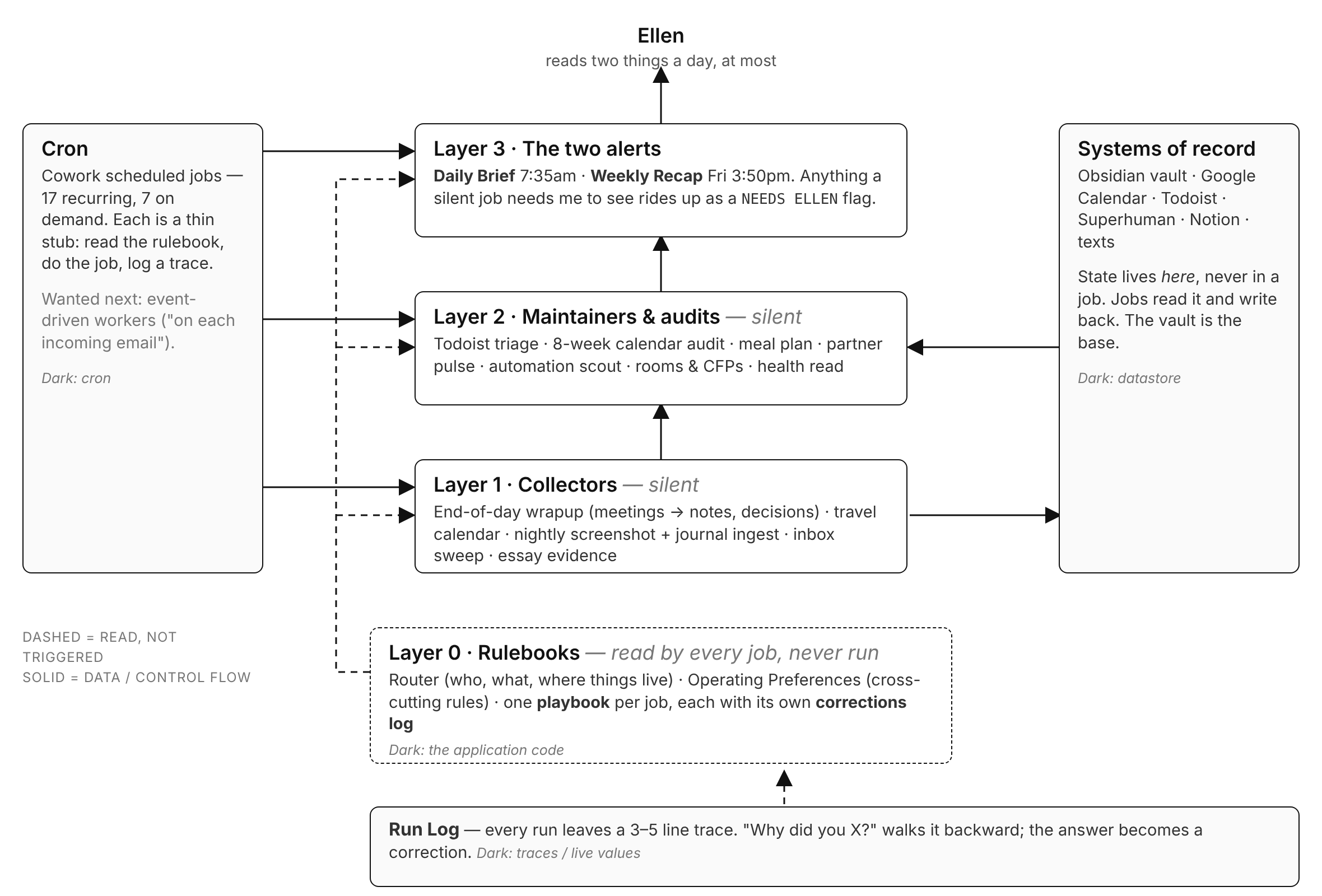
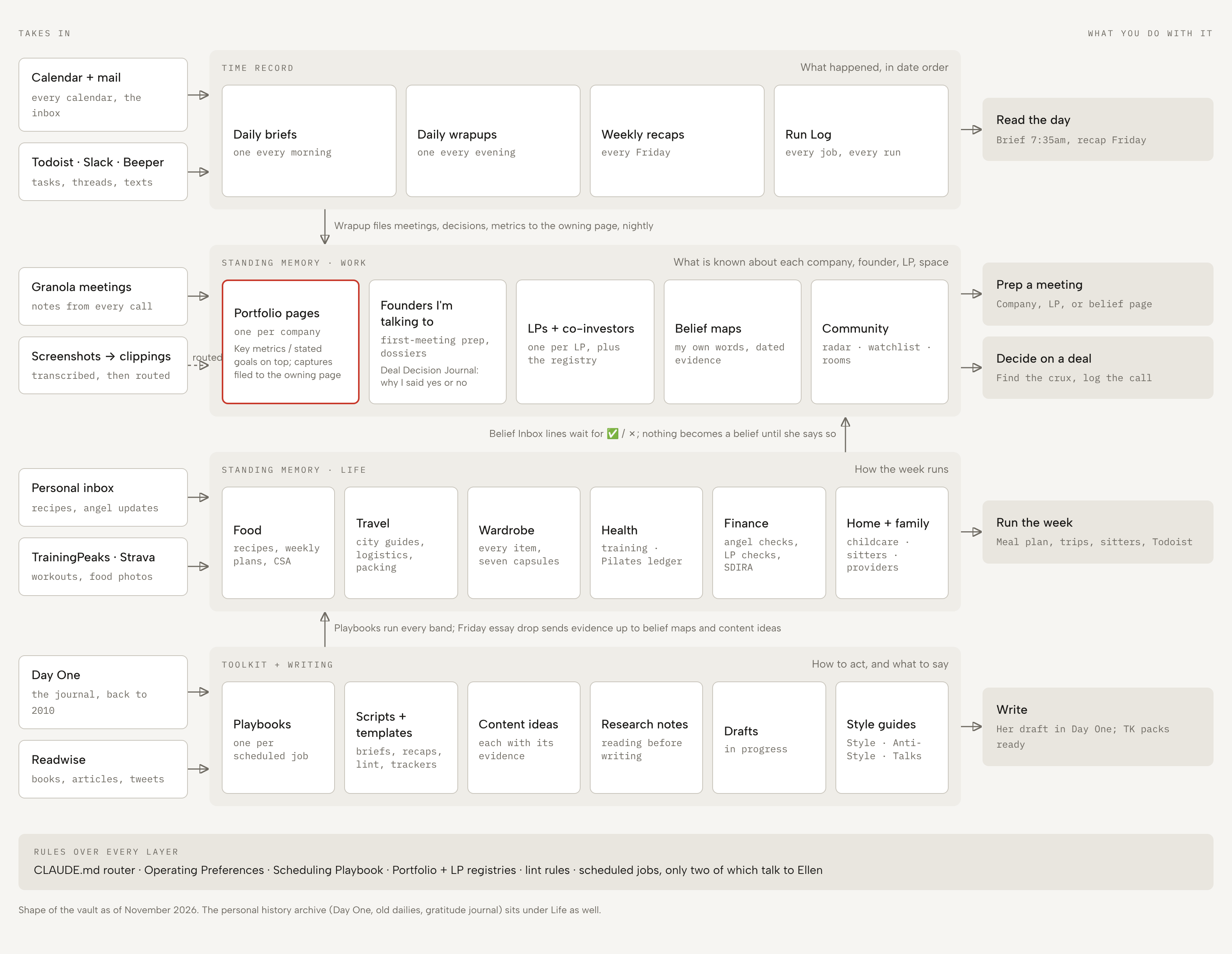
My ‘Database’ is Obsidian. The hierarchy is five top-level folders and a router file for identity, people, vocabulary, and a “for X, read Y” index. The router holds no rules or facts itself. The five folders are:
Boldstart/ — all VC work: Portfolio, New Deals, LP, Networking, Ops
Personal/ — life: Health, Food, Travel, Family, Home, People, Style, Finance, Lists, Beliefs, Records, History
Content/ — inputs and chronological capture: Daily (briefings, reviews, meeting notes by date), Clippings, Readwise, Content Queue
Writing/ — output: Drafts, Content Ideas, Research Notes, Published
System/ — Playbooks (the applications, see below), Operating Preferences (the cross-cutting rules), Goals, scripts
Cron is the primary interaction to trigger work (I use scheduled jobs in Cowork). I’d love to have workers/event-driven options as an alternative trigger. For example, instead of looking at my inbox at night, look at each incoming email.
Playbooks are the “applications” or APIs. I write down all of the things that should happen.
Traces - one of my favorite things about Dark was traces/live values and seeing what had happened. In my system, if I ask a job “why did you X?” it can fully use its run log to walk a path backward to see where the error came from. Then it uses this to improve for the future.
Job first architecture Diagram
Surface first architecture diagram
Deciding what to build - bottom-up vs. top-down
I didn’t start out to do a full personal OS. I started bottom-up from meal planning.
Why meal planning? I am always hangry (everything sounds good and too complicated and I need to eat RIGHT NOW) or not hungry at all (no interest in planning). This was not fun for Tom who still had to do all the work to make sure our family ate food, and deal with a cranky person.
It started from a pretty small application, and evolved to include:
Who is at home for any given dinner, do we have any guests, dietary restrictions
Time constraints on cooking dinner
Item status: what’s perishable, what came in the CSA this week, what is leftover from last week, etc.
Constants: items we always need to buy and cook
Recipes we’re excited about (from NYT, screenshots of other apps, etc).
Generate the meal plan for review
After approval, generate the shopping list (in the order I walk through the store)
I have many comparable workflows (some of which have been built top-down and some bottom-up). When I build bottom-up it reminds me of working on Dark and building tiny programs. When I build top-down it reminds me of being a PM. I’m including a full list at the bottom of the post. I think some tasks are better suited to be built one way or the other.
What I still do myself
I’m sure some of you are curious “did the OS write this?” and the answer is no.
I use the operating system to spend as much time as possible on pushing my unique thoughts forward, and spending time with people.
The specific workflow here:
I wrote my own full draft in DayOne with my major points, completely away from any other tools
I asked my OS to pull in concrete numbers, specific facts, and quotes from my data based on the “TK” spaces I left in my draft
I asked for feedback on my writing, read the feedback, and then re-wrote my draft in DayOne
I let the OS fix typos, I’ve never been good with that
The OS did generate the table showing the full extent of the jobs + how many features each job has.
Recursive Self Improvement (RSI) & Maintenance
These systems are software like anything else. How do you look for low-hanging fruit you can add to your starting system? How do you prevent drift, make sure your specs are up to date, and clean things up so they are using the same underlying pieces of infrastructure?
Collaboration
This all started from Tom and I needing a better meal plan. Recently, Tom told a coworker that he doesn’t have to use AI in his personal life because I’m running the entire system. I hadn’t noticed that because I’m in the system all day. I have little hooks to interact with Tom through it (ex: writing to and from our shared Todoist) - but my system isn’t truly open to anyone else. Should it be? Does it need to be in a business case, or will everything flow through into other layers?
Measurement
It’s hard for me to quantify if the system is working. I do know:
I dropped having a dedicated virtual assistant, and I think I saved time (no coordination meetings - so at least one hour per week there).
I used to be tracking how many meetings I had per quarter that I felt like weren’t worth the time. So far this quarter I’m at 0.
My median time to get to a clear “no” from a first meeting has dropped from 3.5 days to 2 days. I care about getting back to founders quickly, so this alone feels like a huge win.
I haven’t sat around on the couch being sad about the meal plan, and I haven’t forgotten anything while packing.
I’m working MORE hours than ever before - probably because I love playing with the tooling. It doesn’t feel like more. I’m getting to build an entire product for the first time in six years.3
Qualitatively I love it - but it would be great to think about how I can think about this objectively.
Trading Notes
If you’re thinking about any of these - I’d love to demo to each other and chat about some of the big areas that are open spaces.
On Wednesday November 18th I’m going to be at Davis Square Donuts & Bagels in Somerville, upstairs from 8:30am-10am. I’ll be tinkering with my project and would love to meet other people + spend time trading notes. Let me know if you want to come so I can add you to my calendar invite (or just show up) and I’m happy to buy you a coffee/donut/bagel.
Send me an email about your setup so we can compare - ellen@boldstart.vc.
If you want to go deeper, I’m writing some deep dives:
Full Task List
17 scheduled jobs and 7 on-demand ones. Inside them, 1,055 distinct features. 293 of those exist because of a logged mistake — they carry the date of the correction that created them.
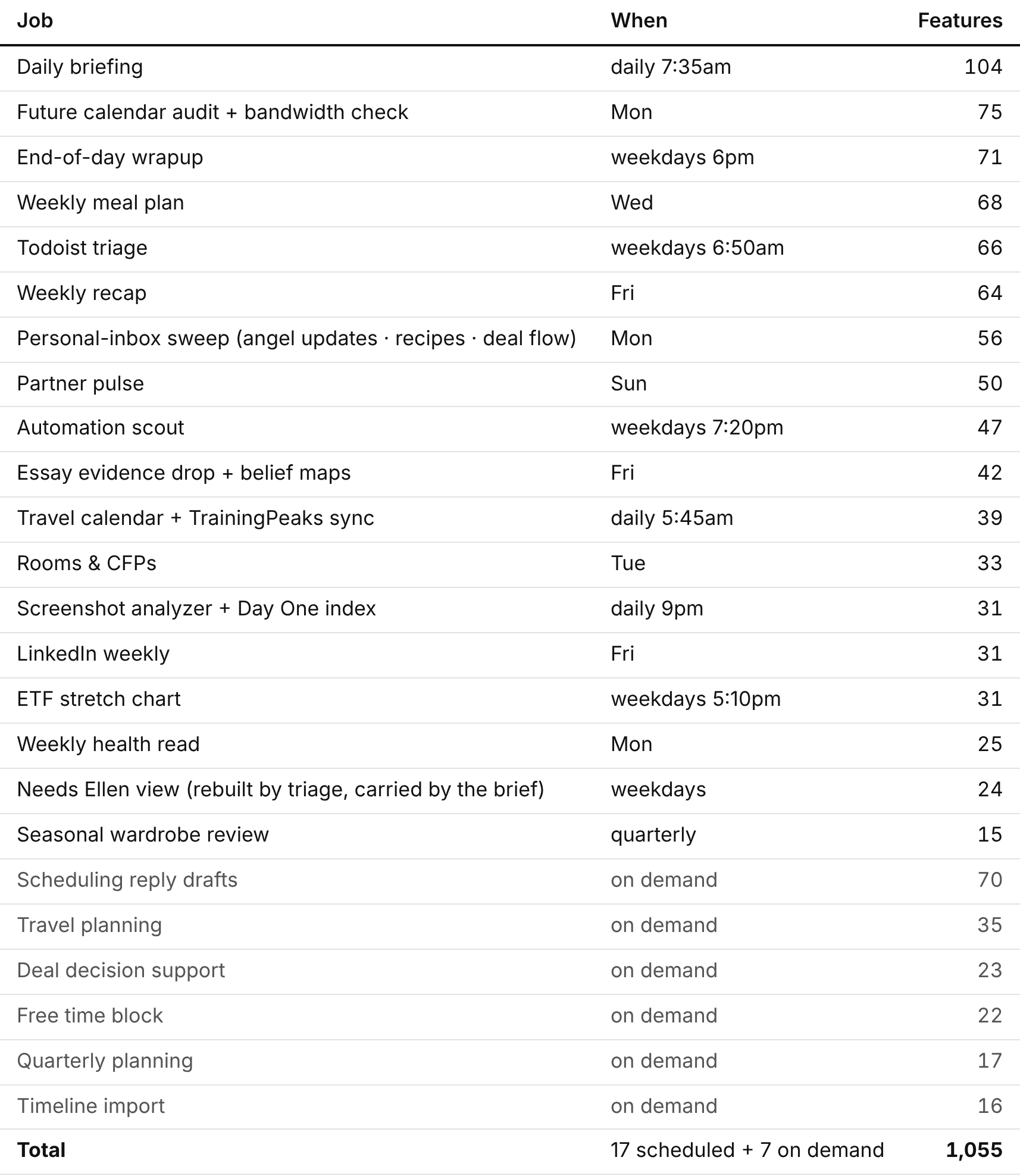
Four detailed examples:
Childcare (daily briefing). Before the brief calls a day “no childcare,” it checks the shared calendar for a “No Nanny” or “No Bennett School” event, then reads my texts with the nanny and the two backup sitters for a confirmation — a text outranks the calendar. On a no-childcare day it stops placing task blocks on my calendar and gives me a list instead; with a confirmed sitter, blocks and meetings run inside the sitter’s hours (which might vary from the usual schedule) and end before handoff. (Three separate corrections built this one.)
My last word wins (daily briefing). If I close a “reply to X” task myself, it reads my Sent mail before carrying anything forward. Closed by me + a sent email = done, logged, never re-flagged.
Pitch prep (daily briefing). For every first meeting it reads the intro thread back to its root, pulls the deck, and web-checks the founder and the funded competitors, then writes ~150 words of prep into that meeting’s row. I hope this makes meeting with me more pleasant.
Essay evidence (Friday). Every week it reads my meeting notes, journal entries, Readwise highlights, and the screenshots I clipped, matches each passage against the seed paragraph of every essay idea I have open, and appends the hits, verbatim, with who said it, where, and the date — to that idea’s file. My own lines are marked as mine; someone else’s statement is noted so I can ask them if I want to use it. When an idea reaches three pieces, it gets its own file. So when I sit down to write or think, the fodder is already filed. (For example, this post’s 2011 footnote came out of that pile).
I know this because my Personal OS could go back through my journals all the way to my freshman year in high school. I still need to digitize the physical design notebooks that I started keeping after Vital Ideation from ~2008-2012.
It definitely COULD book the ticket, but old habits die hard and I opened up the website myself.
I know this because my OS logs everything - from meetings to the digital dust from when I answer emails at 5am or 10pm.
the collaboration question seems testable without opening the whole system: could Tom change one dinner constraint through the shared Todoist and see the revised plan there? if that works without asking you to interpret the change, the meal workflow has become shared even if the rest stays personal.
i love the idea of a personal OS. curious which part of it you use the most day to day.